

Issue No. 17 2009 — Bernard Stiegler and the Question of Technics
abstracts
Transformation as an Ontological Imperative: The [Human] Future According to Bernard Stiegler
By Stephen Barker
Bernard Stiegler's consistent interrogations respond to both the confused obfuscation and the positive drive of technics and transformation, as central concepts underlying all of Stiegler's thought and writing from Technics and Time 1 (1994/1998) through his most recent analyses of education, “telecracy,” democracy, industry, etc., whether he is addressing the question of technics directly or tangentially. What is being “profoundly transformed,” according to Stiegler, is nothing less that the nature of “the human” itself, by which Stiegler does not mean some safe, traditional notion of “human nature,” since for Stiegler technics and technology are temporally prior to “the human” and obviously, therefore, to any humanism; our need to attempt an understanding of the process of technical evolution is a vitally important ontological (and existential) imperative, an “anthropological technics” transforming both customary human/animal anthropology and “man the tool-maker.” Stiegler asserts that the human is the product, not the cause, of technical evolution, an evolution whose grounding concept is “technics.” In this sense, “the technical,” “techniques,” and “technology” all manifest aspects and modes of operation of technics. For Stiegler, the world is not “to hand,” as it is in Heidegger; rather, “the hand learns from the tool”: “technical” or “technological” innovation is thus a matter of trying to catch up with technics and technologies. This becomes more challenging when we consider that speaking and writing are technical structures – as is language (and the nature of language) itself. “The human” is a result, a subset, of technics. Stiegler erases the magical thinking of a non-technical pre-human, thus transforming the nature of what is “proper to the human.” Ranging across a number of Stiegler's works and concepts, the essay lays out their radical transformativity.
The Duck and the Philosopher: Rhythms of Editing and Thinking between Bernard Stiegler and The Ister
By Patrick Crogan
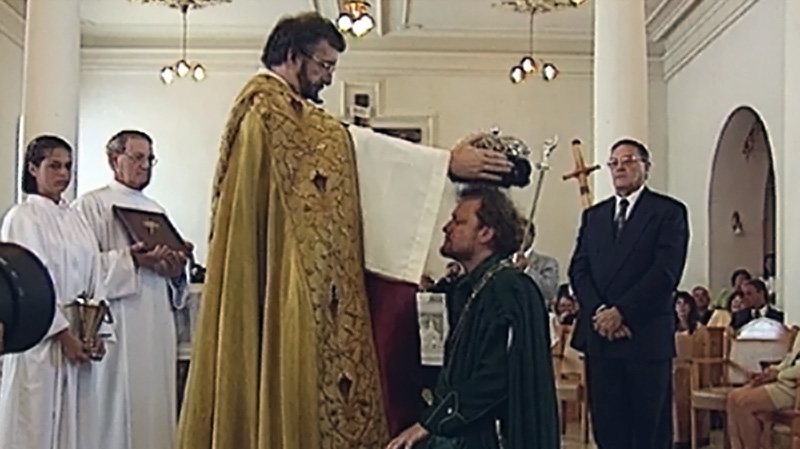
The Ister (Ross and Barison, 2003)—part documentary, travelogue and philosophical meditation supplementing Heidegger’s meditation on Holderlin’s poem about the Danube—opens and closes with sequences of a duck waddling along the bank of the river. The intervening film, all 3 hours of it, is in effect a large insert edit between these two sequences, or rather, this single sequence. Seen in this way, and given the significant involvement in and engagement with Bernard Stiegler’s thinking of technology that The Ister evinces (interviews with Stiegler, among others, take up much of the time of this insert), the film invites consideration in terms of his theorisation of cinema as key representational technology of the Twentieth century. His published work on cinema postdates the film but it nonetheless represents an intriguing anticipation of and in some ways response to his both theoretical and polemical approach to cinema. This paper will outline and examine some major tenets of Stiegler’s account of cinema by trying to time the momentary duck’s walk that is the extended duration of The Ister. This will involve an editing project of its own that cuts between analysis of the film, theories and practices of editing and Stiegler’s post-phenomenological account of consciousness
The Cosmeceutical Face: Time-Fighting Technologies and the Archive
By Grayson Cooke
In this paper I will discuss the implications of cosmetic "anti-aging" technologies and their marketing discourses for an understanding of the human face as a kind of archive, as a repository of time and memory. I will do this in relation to the writings of Bernard Stiegler and Jacques Derrida. While neither Derrida nor Stiegler talk at any length about the face or about cosmetics, their writings on the archive, temporality, and technology as "tertiary memory," illuminate the questions that revolve around the anti-aging industry's relation to time and the face, in a particularly appropriate manner. With reference to these writings, I will argue that cosmetic anti-aging technologies - frequently understood and marketed as "cosmeceuticals" - constitute the face as an archive at the same time that they work to limit the functioning of the face as an archive. This constitution of the face as archive occurs in the context of the beauty industry and social expectations about gender, youth and beauty; in the context of medical and technological developments related to the anti-aging industry; and in relation to real-time tele-technologies and the technologies of memory, which are intrinsically related to temporality and archivization. In an era characterized by, on the one hand, a massive industry of anti-aging biomedical and cosmetic interventions into the effects of time and aging on the human body, and on the other, by the profusion of digital technologies of real-time reportage and recording and information storage and retrieval, and by the concomitant "crises" of format obsolescence and archival preservation brought about by the speed of development and dissemination of such technologies, cosmeceuticals, ironically, preserve the face by not preserving it.
Politics and Aesthetics, or, Transformations of Aristotle in Bernard Stiegler
By Daniel Ross
Bernard Stiegler argues for the necessity of pursuing the question of the relation between politics and aesthetics, because today aesthetics has become a vehicle for calculating and controlling desire, including both economic and political desire. The problem is that this attempt to calculate and control encounters a limit, becoming destructive of desire itself. Establishing a future for individual and collective becoming requires understanding the reason for this limit. In psychoanalytic terms this might be understood as the susceptibility of desire to regress to drive-based states. Stiegler's understanding of this susceptibility, however, also relies on Aristotle's account of three kinds of soul. By grasping the relation between the vegetative, sensitive and noetic souls compositionally rather than oppositionally, Stiegler is able to explain the limits of control in terms of the intermittence of the noetic soul's noeticity. The sensitivity of the noetic soul is perpetually capable of being lured by the sensational, which when it is pursued systematically tends to reduce the temporality of desire to the instantaneous (dis-)satisfactions of the drives. Only if this question of the individual and collective loss of savoir faire and savoir vivre, which together Stiegler calls general proletarianisation, is addressed, could our political and industrial model be transformed such that it fosters new desire, rather than continuing to contribute to its exhaustion.
Culture Industry Redux: Stiegler and Derrida on Technics and Cultural Politics
By Robert Sinnerbrink
This essay seeks to further the critical reception of Stiegler's philosophy of technology by situating his work within the legacy of critical theory (broadly understood) and deconstruction (broadly understood). Drawing on what Richard Beardsworth has described as Stiegler's 'Left-Derrideanism'-his radical re-thinking of the problem of technics and related call for a "politics of memory"-I argue that Stiegler's transformation of both Heidegger and Derrida retrieves and renews the interrupted Frankfurt school tradition of culture industry critique. What we might call Stiegler's 'deconstructive materialism' reinvigorates the project of a cultural politics that would take place in the intersection between culture, technics, and politics in the more conventional sense. In this respect, Stiegler's culture industry redux points to a number of important practical cultural responses to the debilitating malaise that increasingly afflicts politics in liberal capitalist democracies. I conclude by suggesting what such a Stieglerian 'cultural politics of memory' might entail.
Animality, Humanity, and Technicity
By Nathan Van Camp
The last decades have witnessed a renewed interest in philosophical anthropology. Philosophers working in this field no longer discuss human nature as such, but inquire into the various ways in which scientific, religious and metaphysical discourses on this theme underpin certain power relations. Of late, the focus of this discussion has shifted towards the relation between man and animal. This essay will examine the fertility of this approach by comparing Giorgio Agamben’s “anthropological machine” with Bernard Stiegler’s notion of technics as elaborated in his multi-volume work Technics and Time. We will try to show that the way in which Agamben elaborates the former concept is related to Stiegler’s critical reading of the paleontologist André Leroi-Gourhan. But whereas Agamben ends up expressing his wish to put a stop to this “machine” in a (quasi-)religious vocabulary, Stiegler argues that the anthropocentrism inherent to it is a result of forgetting “originary technicity.”
Stiegler and Marx for a Question Concerning Technology
By Irmak Ertuna
In this paper I elaborate on the conceptual framework shared by Marx and Stiegler. Stiegler criticizes Marx for failing to conceive technology as anything other than means and for not assessing the role of technology in the formation of psyche. However, a non-essentialist reading of Marx demonstrates that Marx has distinguished objectification of the human through material production of the world (i.e. exteriorization) from the historical fact of alienation. Moreover, for Marx, the human has always been constituted through the activity of production that is at once technological, social, and transformative. In order to counter the neo-liberal mystification of technology that manifests itself as both technophilia and technophobia, we need to resort to a Marxist understanding of technology as pharmakon, or as Stiegler writes, "at one and the same time human power (puissance) and as the power of the self-destruction of humanity" (Technics 85).
Unweaving the Program: Stiegler and the Hegemony of Technics
By Andrés Vaccari
This paper examines the empirical and historical aspects of Bernard Stiegler's philosophy of technology, arguing that it consolidates, rather than challenges, a number of traditional ontological distinctions; in particular, those between living and technological, genetic and non-genetic, and nature and culture. The two main foci of criticism are Stiegler's historical claims regarding the trajectory of technological development, and his questionable use of informatic models and writing metaphors to think about technics. The notion of 'program' is examined, as well as its applicability in the context of enculturation. Finally, the paper offers an alternative myth of technics that aims to rescue what Stiegler's philosophy forgets: the irreducible heterogeneity of technology.
Prolegomena to a Future Robot History: Stiegler, Epiphylogenesis and Technical Evolution
By Andrés Vaccari & Belinda Barnet
How does one tell the story of a machine? Can we say that technical artefacts have their own genealogies, their own evolutionary dynamic? Bernard Stiegler feels this question is an urgent one, and calls for more research into technical evolution in his book, Technics and Time. In the following essay, we will be answering Stiegler's call. Firstly, we will be reviewing the work of several key theorists from different disciplines who have attempted to understand technical evolution, many of whom Stiegler uses in his own work; in order of appearance, paleontologist Niles Eldredge, the philosophers Jacques Derrida and Manuel DeLanda, and archeologist André Leroi-Gourhan. We will then lift some ideas and problems from each of them in an effort to construct a prolegomena to the history of a technical machine, a history which is not included here and which has yet to be written. We want to build a theory of technical evolution.